An Arrival Plan for Guests Who Do Not Know the Venue
Help guests move from the street to their seats with clear cues, a welcoming person, and a simple plan for late arrivals.
Help guests move from the street to their seats with clear cues, a welcoming person, and a simple plan for late arrivals.
Hosting · 9 min read
A guest steps out of a rideshare onto a quiet side street, checks the invitation, then looks at two doors that both seem plausible. The ceremony is about to begin, but nobody at the curb can tell them where to go. A thoughtful arrival plan prevents that small uncertainty from becoming the first thing guests remember about your event.
Build the route as a guest will experience it: from the place they arrive to the moment they find a seat. Then give each decision point a clear cue, assign a real person to welcome people, and decide how late arrivals can join without interrupting the ceremony. The plan need not be elaborate. It needs to work for someone who has never seen the venue.
Walk the route from the guest’s starting point
Begin with the invitation and the directions guests will actually use. Write down the venue name, street address, entrance to use, and any useful landmark. If the venue sits inside a larger property, name the building or courtyard rather than relying on a broad campus address. If there are separate entrances for events and daily business, say which one is right.
Next, trace the route from the likely drop-off point. At the venue, walk from the street, parking area, or transit stop to the ceremony room. Follow the path at an unhurried pace and notice where a visitor might hesitate: a fork in a garden path, a lobby with several doors, a staircase, a reception desk, or a corridor that looks private. Those are the places where a cue or a person will help most.
Check practical details while you walk. Is the path visible after dark? Could a sign be hidden behind a parked vehicle or an open door? Is there a step-free route, and can guests find it without asking at the wrong entrance? If the venue has access arrangements, confirm the route with venue staff rather than guessing. Give guests clear directions that respect their privacy and comfort, such as how to request assistance or where an accessible entrance is located.
Keep the route description short enough to scan. A simple note might say: “Enter through the courtyard gate, follow the lanterns to the stone hall, and check in just inside the left door.” Only include cues that will be present when guests arrive. If lanterns are part of the venue’s regular decor but may be removed, choose a more dependable landmark.
Give guests one clear cue at each decision point
Guests rarely need a sign at every step. They need reassurance where the route changes or the next destination is not obvious. Think in terms of decisions: turn here, enter this door, continue down this hall, or check in at this table. A sign that says “Wedding” at the street may be less useful than one that points to the actual entrance.
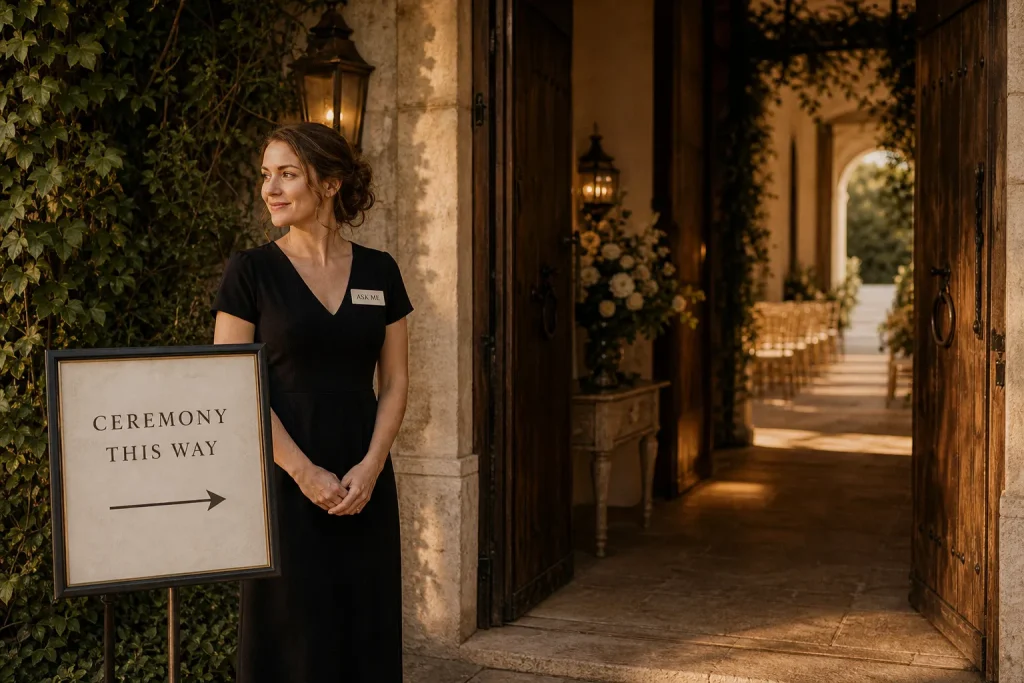
Use plain language and a visible direction. “Ceremony this way” with an arrow is easier to act on than a decorative sign that lists the couple’s names but leaves the route unclear. Keep important text large enough to read from the path, and place signs where guests can see them before they reach the choice. A sign tucked beside the door it identifies may come too late to help.
Choose materials that suit the setting and hold their position. A framed paper sign can work indoors; a weighted board or venue-approved stand may be better outside. Ask before attaching anything to walls, trees, or historic surfaces. For a windy courtyard, a loose sheet on an easel is an invitation to chase paper across the grounds. The venue may have sign holders or a preferred way to secure them.
Make the cues consistent. Use the same wording for the entrance on the invitation, a reminder message, and the sign itself. If the directions call it the “garden door” but the sign says “north entrance,” guests have to solve a needless translation puzzle. Keep the visual style pleasant, but let legibility lead.
It is not worth labeling every chair, doorway, and stretch of hallway if the route is already obvious. Too many signs create clutter and can make guests wonder whether they have missed a special instruction. Put guidance where a real choice occurs, then let the venue do the rest.
Assign a person to welcome and orient guests
A sign can point, but it cannot notice a guest who looks uncertain, carry a mobility aid, answer a question about coats, or explain that the ceremony room is still being prepared. Assign a designated point of welcome: someone whose job is to greet arrivals and help them reach the next place. Depending on the event, this might be a trusted friend, a coordinator, or a venue attendant who has agreed to take on the role.
Choose someone who will not be pulled into another essential duty at the same time. A person expected to usher the wedding party, manage gifts, and welcome guests may not be available when the first arrivals need help. Tell the welcome person where to stand, what they should say, and who to contact if a question is outside their remit.
Share a concise briefing before the event. Include the entrance guests should use, the route to the ceremony, the location of restrooms and coat storage, the seating arrangement, and the name of the venue contact. Clarify whether the welcome person should direct guests to open seats or leave seating questions to an usher. They should also know what to do if someone arrives needing assistance or asks about a dietary or accessibility matter.
Make the person easy to recognize without turning them into another sign. A simple “Ask me” badge, a small ribbon, or a clear greeting spot beside the entrance can help. The welcome point should not block the doorway or the route through it. If guests arrive in a short wave, a person standing just beyond the entrance can greet them while keeping the passage clear.
Plan the handoff from greeting to seating
Once guests enter, the next question is often where to go and where to sit. Decide whether guests should check in, leave coats, wait in a reception area, or proceed directly to the ceremony space. Put those actions in an order that avoids backtracking. If coat storage is past the ceremony room, for example, guests may not know whether to walk by their seats first or stop for coats.
For open seating, tell guests that they may choose any available seat, and make sure the first few rows have any reserved signs needed. For assigned seating, place the seating chart where guests can pause without blocking the entrance. If names are difficult to locate, have an usher ready to assist rather than asking arrivals to search while others queue behind them.
Consider who may need a quieter or more accessible route. A long line at a narrow doorway can be tiring, and a crowded lobby can make directions hard to hear. Keep an alternate route or a staff member available if the venue offers one. Avoid making assumptions about what a guest can manage; give people a discreet way to ask for help.
Imagine a small ceremony in a neighborhood arts center. The entrance opens onto a lobby with a gallery door and a corridor to the event room. The host puts one arrow sign outside, asks a friend to greet guests just inside, and places an usher near the seating chart. The invitation names the courtyard entrance. Guests can follow the arrow, ask the greeter about coats, and move to the usher for a seat; someone who takes the wrong door can be redirected before reaching the gallery. The useful result is not fancy decor but a sequence of decisions that feels easy to follow.
Decide what happens when someone arrives late
Late arrivals are easier to accommodate when the plan is settled in advance. Ask the venue or ceremony lead where a person can wait briefly and when it is appropriate to enter. For a ceremony with a processional or a quiet reading, the answer may be to hold guests near the entrance until a natural pause. At a more informal gathering, the welcome person may be able to guide them straight to an open seat.
Name the person who will make that call. It might be the usher, the venue coordinator, or someone designated by the ceremony lead. They should know how to reach the person managing the ceremony and where the latecomer can wait without standing in a busy doorway. A clear handoff is kinder than asking a late guest to decide whether to interrupt.
Tell the late-arrival contact where to find the instructions. If the door will be closed during part of the ceremony, include a phone number or a message route in the guest reminder, with permission from the person whose number is shared. Avoid posting private contact details on a public sign. A simple message such as “If you arrive after the ceremony begins, please contact the welcome person at the courtyard entrance” gives the guest an action to take.
Keep the backup realistic. If the greeter must leave to help someone, another person should know how to cover the entrance. If there is no second host, ask the venue staff whether they can handle that moment. Do not rely on a sign to manage a situation that requires judgment, especially when the ceremony is underway.
Confirm the plan with the venue and the people carrying it out
Before the event, share the route and arrival roles with the venue contact. Confirm which doors will be open, where signs may stand, whether a staff member will be present, and whether the planned path changes after dark or during another event. Ask about any rules for photography, building access, or keeping exits clear. Venue staff can flag details that are easy to miss when planning from an invitation or floor plan.
Send guests the final directions in the same place they are most likely to check: the invitation, a short event page, or a reminder message. Include the exact entrance and the cue they will see. If parking or public transit is relevant, keep that information separate from the few instructions needed to enter and find the ceremony. Guests should not have to sift through a long note to locate the door.
Then brief the welcome person and usher together. Walk through who greets, who answers seating questions, who handles late arrivals, and who calls the venue contact if something changes. If the entrance is moved, the signs are missing, or weather alters the route, the people on site should know which cue to update and how to redirect guests.
When guests do not know a venue, a smooth arrival comes from small, connected choices: directions that name the right door, signs at genuine decision points, a person ready to welcome, and a calm route for anyone who comes late. Give each role a clear handoff, and the entrance can feel less like a puzzle and more like an invitation to come in.