Borrowed, Found, and Reused: Build a Table Look from What Is Available
Start with one visual direction, take stock of what you already have, and add only the pieces that solve a real gap.
Start with one visual direction, take stock of what you already have, and add only the pieces that solve a real gap.
Style · 5 min read
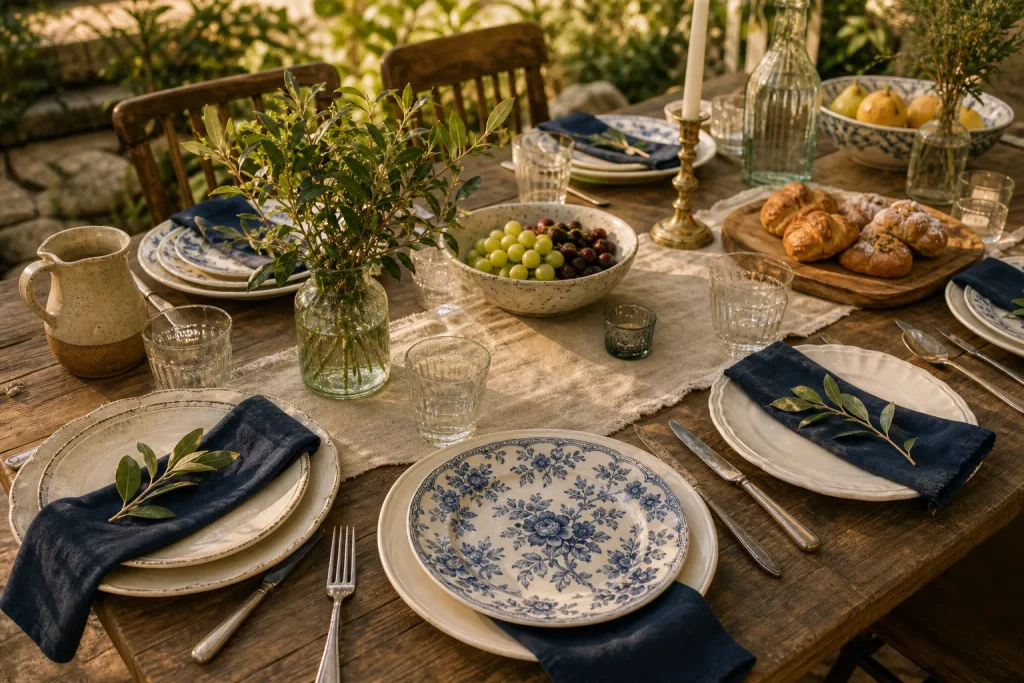
A stack of mismatched plates on a kitchen counter can look like a problem until you set one beside a linen napkin and a green branch. Suddenly, the differences feel intentional. A table with character doesn’t need a matching set; it needs a few choices that help its pieces belong together.
Choose a direction before you start collecting
Pick one visual idea you can describe without a mood-board speech: “warm and earthy,” “bright garden lunch,” or “quiet, candlelit dinner.” Use it to guide your choices, not to force every object into the same color or finish.
A useful direction has a small palette and a texture or material to repeat. For a relaxed garden table, that might mean cream, leafy green, and muted blue, with woven baskets or simple glass. For an evening gathering, try ivory, deep red, and brass, softened by linen. Repetition is what makes variety read as a decision.
Keep the setting in view, too. A heavy arrangement of dark objects may feel out of place on a sunny picnic table; delicate pale pieces can disappear against a white cloth. Start with the room, outdoor backdrop, or table surface, then choose a direction that complements rather than competes with it.
Take inventory in sensible layers
Look through cupboards, storage bins, and the resources of people who have offered to lend a hand. Gather possible pieces in one place, then sort them by job rather than by owner: plates, serving dishes, glassware, flatware, linens, candleholders, and decorative accents.
Check what actually needs to be set at each place. A meal might call for a dinner plate, a glass, a fork, a knife, and a napkin; a cake-and-coffee gathering needs something different. Let the menu and the way you plan to serve it determine the essentials. Don’t recruit a soup spoon for a menu that has no soup.
Make a second pass for practical condition. Look for chipped rims, sticky drawer residue, loose candleholders, and napkins that need washing or ironing. If borrowed items are fragile or have sentimental value, ask how they should be handled and returned. A useful inventory is not just what exists; it is what is suitable and available for the occasion.
Use repetition to make mismatches feel deliberate
Variation works best when at least one element repeats. Different dinner plates can sit comfortably together if the glasses match. A collection of assorted glassware may look unified beside the same napkin color at every place. Repeat a shape, finish, color, or material, and let the other pieces vary.
Choose a simple anchor that appears across the table. It could be cloth napkins in one shade, clear glasses, a shared serving platter, or a narrow runner. The anchor doesn’t have to be expensive or dramatic; its job is to give the eye a familiar point to return to.
Imagine you have blue-and-white plates from one cupboard, plain white plates borrowed from a neighbor, and clear tumblers in mixed shapes. You decide on a relaxed blue-and-cream direction, use matching navy napkins to connect the plate patterns, and place the tumblers together along the table. The pieces still differ, but the repeated color and clear glass give them a shared rhythm.
Fill real gaps, not imagined ones
After arranging the pieces you have, mark what is missing. A bare spot in the plan is a reason to look for a solution; a vague feeling that a table “needs more” is not. Perhaps there are enough dinner plates but no serving bowl, or the cloth napkins don’t cover the full guest list. Name the gap before adding anything.
Try the least complicated fix first. Borrow a serving platter, use a clean bowl already in the kitchen, or choose paper napkins that suit the palette if laundering cloth ones is impractical. If the table looks flat, a runner or a few leafy stems may help more than a collection of small decorative objects.
One invented scenario: Say you’re setting a brunch table with enough plates and glasses but no matching centerpiece. You notice that the center looks bare, not because it lacks ornament, but because the serving dishes are all at one end. Moving a fruit bowl and a pastry plate toward the middle may balance the arrangement without a new purchase.
Keep the surface useful and the decor modest
Decor belongs around the meal, not in the way of it. Leave room for serving dishes, hands, and conversation. A low arrangement of clipped greenery in a small jar is often easier to live with than tall stems that block sightlines. Candles can add warmth, but place them where sleeves and passing dishes won’t brush them; follow the venue’s rules and use stable holders.
Mixing materials adds interest without adding clutter. Pair cotton or linen with glass, ceramic with wood, or a polished metal utensil with a woven placemat. A few contrasts are plenty. If every place has a different napkin fold, centerpiece, and decorative object, the table may feel busy rather than collected.
Not worth the effort: sourcing a special item for every guest just to make each place setting unique. It creates extra tracking and can distract from the shared table. Save personal touches for the menu card, a short note, or a small detail that has a clear connection to the gathering.
Make borrowing and cleanup part of the design
Before setting the table, keep borrowed pieces grouped by owner or marked with a discreet note. That makes packing easier and lowers the chance that a treasured serving spoon disappears into the kitchen clean-up. Confirm whether items should be washed, dried, or returned in their original boxes.
Also think about the route from table to sink. If plates are delicate, make a clear place to stack them safely. If linens need laundering, keep them separate from food scraps and candle wax. These small choices won’t show in a photograph, but they make a resourceful table genuinely easier to host with.
Once the essentials are in place, step back and remove one thing if the surface feels crowded. A thoughtful table is not a display of everything you could borrow; it is a comfortable arrangement of what serves the meal, suits the setting, and belongs to the visual direction you chose.