A Ceremony Script That Sounds Like the People in It
Build a ceremony around the moments guests need, then use specific prompts and a simple read-aloud edit to make the words feel like yours.
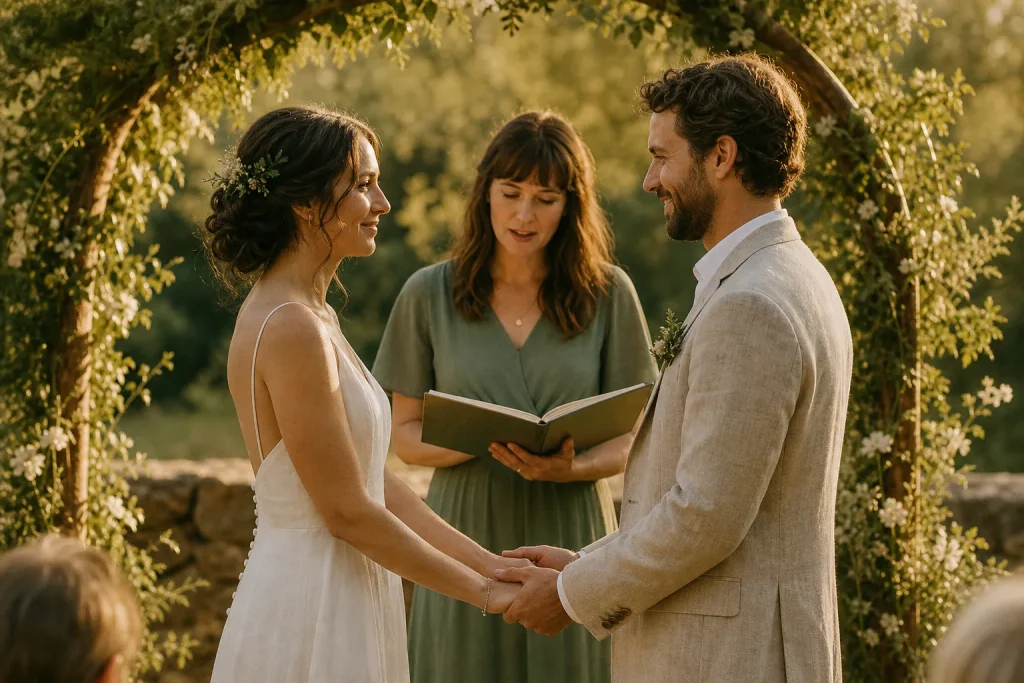
Build a ceremony around the moments guests need, then use specific prompts and a simple read-aloud edit to make the words feel like yours.
Ceremony · 8 min read
The officiant sets a folder on the lectern, your partner smooths a sleeve, and the room quiets. Then the first sentence arrives: “We are gathered here today…” It works, but it could belong to almost anyone. A ceremony script feels personal not because every line is custom-made, but because the essential moments are clear and the language around them sounds like the people standing there.
Start with a sturdy outline. Add personal details where they carry meaning, and edit any borrowed passage that feels more polished than true.
1. Decide what the ceremony needs to do
Before choosing readings or writing vows, agree on the work the ceremony must accomplish. Usually, guests need to understand why they are gathered, hear the couple make their promises, witness the exchange of rings or another chosen symbol, and know when the ceremony is complete. The exact customs depend on faith, culture, family, and the couple’s wishes.
Write those essential moments in plain language on one page. You might list a welcome, a brief reflection, vows, rings, a pronouncement, and a closing invitation. This is not the script; it is the frame that keeps the script from becoming a collection of attractive but disconnected passages.
Ask each other: What do we want guests to understand? Which traditions feel important to include? Is there anything we do not want the ceremony to suggest about our relationship? Answering together helps prevent a script from inheriting assumptions simply because they appear in a familiar template.
2. Choose the voice before drafting the lines
A ceremony can be formal without sounding stiff, and warm without turning into a stand-up routine. Talk about the voice you want in terms that are easy to hear: calm and direct, gently funny, reverent, conversational, or a blend. Then name the limits. For example, you might welcome one affectionate joke but not a string of stories at either partner’s expense.
Think about who will speak each part. The officiant may naturally use longer, more measured sentences; the couple’s vows may be more intimate and plainspoken. A relative reading a poem should not have to imitate the officiant’s style. A little variation makes the ceremony sound human, as long as the transitions still feel coherent.
It helps to picture the actual room and audience. A line that feels intimate in a kitchen may sound too private in front of relatives and friends. A quiet ceremony in a garden may not call for the same volume or formality as one in a large sanctuary. Choose a voice that fits the people and setting, not an imagined ideal of what a wedding is supposed to sound like.
3. Give every speaker a clear job
Build the outline around speakers as well as moments. The officiant can welcome guests, explain a ritual, guide the vows, and announce the ending. The couple can make promises and exchange rings. A reader can offer a poem, prayer, or short passage. Guests may be invited to respond or simply to witness. Assigning each person a clear role prevents several speakers from repeating the same message.
For every contribution, ask what it adds. Does the reading express an idea the couple wants present? Does the officiant’s reflection connect two people’s values to the promises they are making? If a passage only fills space between scheduled moments, it may not need to be there.
Keep transitions in the outline. A reader needs to know when to approach and when to return to their seat; the officiant needs a sentence that introduces the reading and brings attention back to the couple. These small handoffs make the ceremony easier to follow, even when the words themselves are simple.
4. Find personal language with specific prompts
Generic phrases are easy to reach for because they are familiar. To move past them, ask questions that call for a particular memory, habit, or choice. What ordinary task do you enjoy doing together? When did your partner make a difficult day feel manageable? What small promise would you be glad to keep in everyday life? Which quality do you admire that your friends might recognize, too?
Write down the answers separately before comparing them. A few concrete details are often more revealing than a full biography. “You remember to bring tea when I’m working late” gives the listener something to imagine. “You are always there for me” may be sincere, but it leaves the meaning broad. Keep the detail only if both partners are comfortable sharing it with the room.
Say you and your partner want to include a reference to your Sunday cooking ritual. You each write one sentence about what it means: perhaps one mentions the flour on the counter, while the other describes how you decide together what to make. You could use one brief image in the officiant’s reflection and leave the rest for a private conversation. The expected result is a line guests can picture without making the ceremony feel like an inside joke.
Personal language does not require a long origin story. A short, chosen detail can make a promise sound grounded, while too many anecdotes can crowd out the reason everyone is gathered.
5. Write vows around promises you can recognize
Vows are promises, not a contest in poetic language. Begin by choosing a few commitments that reflect the relationship you actually have: making room for honest conversation, sharing decisions, offering support through change, or preserving time for the things you enjoy together. A good promise is specific enough to mean something and broad enough to remain useful as circumstances shift.
Partners do not have to write identical vows. They can agree on a similar length and tone while keeping the wording personal. If one person prefers a traditional formula, both can decide whether to use it as written, adapt it, or pair it with a short individual statement. Check any required wording with the officiant or relevant faith leader before making changes.
Read vows aloud at an ordinary speaking pace. Mark any sentence that makes you stumble, sounds unlike something you would say, or depends on an audience reaction. There is no need to share every private feeling. The goal is to make promises clearly and honestly, not to disclose more than you want.
6. Keep readings and rituals connected to the couple
A reading need not mention marriage to belong in a ceremony. It can speak to patience, friendship, care, faith, or another value the couple wants to honor. What matters is the connection. Before choosing a passage, finish this sentence: “We want this here because…” If the answer is hard to explain, keep looking or let the ceremony breathe without a reading.
For a cultural, religious, or family tradition, ask what the ritual means and how it is usually carried out. A knowledgeable officiant, elder, or community leader can help with language and respectful practice. If a ritual is being adapted, agree on what must remain intact and what can be changed. Avoid using a custom as decoration when its meaning is not understood.
One well-chosen reading or ritual often has more room to resonate than several that make the same point. There is no prize for filling every pause. This is also a good place to distinguish between a tradition that matters to the couple and one included only because someone expects it.
7. Use a borrowed passage as raw material
Templates, poems, and sample scripts can help when a blank page feels daunting. Treat them as source material for structure, not as a voice the couple must adopt. Keep a borrowed line only if you understand what it says, believe it fits, and feel comfortable hearing it spoken aloud under your names.
Try a simple edit for any passage that feels borrowed. First, circle abstract or grand phrases that could apply to nearly anyone. Next, underline the specific idea you want to keep. Then say that idea in ordinary words you might use with a trusted friend. Finally, read the revised passage aloud and check that it still means what you intend.
For instance, a line about “two souls becoming one” might not fit a couple who wants to emphasize partnership between distinct people. They could preserve the idea of joining their lives while describing the choice as building a shared home or making decisions as a team. That is a change in meaning as well as style, so both partners should approve it.
Do not spend an evening replacing every familiar word with an elaborate synonym. That kind of polishing can make a script sound even less natural. The useful edit is the one that makes the meaning clearer and more truthful.
8. Read the whole script aloud and remove what repeats
A script that looks elegant on a screen can become wordy when spoken. Read it from the welcome through the closing, ideally with the officiant and any readers. Use the actual names, practice the transitions, and pause where the room may need a moment to respond. A printed copy should make it easy for each speaker to find their place, but do not let formatting distract from the words.
Listen for repeated ideas. If the welcome explains that the couple values commitment, the reflection repeats it, and the vows make the same point again, decide where that idea lands best. Keep the strongest version and trim the echoes. Also look for unexplained references, long sentences, jokes that need context, and words a speaker would never use in conversation.
Ask the officiant to confirm the order of events, any required language, and how the couple should be cued. If the ceremony includes religious or cultural requirements, consult the appropriate leader rather than relying on a generic script. The officiant can also flag practical questions, such as where a reader stands or who holds the rings.
At the end, leave a little room for the moment itself. A ceremony does not need a line for every breath or movement. When the structure is clear, the speakers can focus on the promises, the people listening, and the words they chose to say.