The Guest Count Is a Planning Tool, Not a Scorecard
A hypothetical couple works through a guest-list range by starting with the gathering they want, the room they have, and the invitations that matter most.
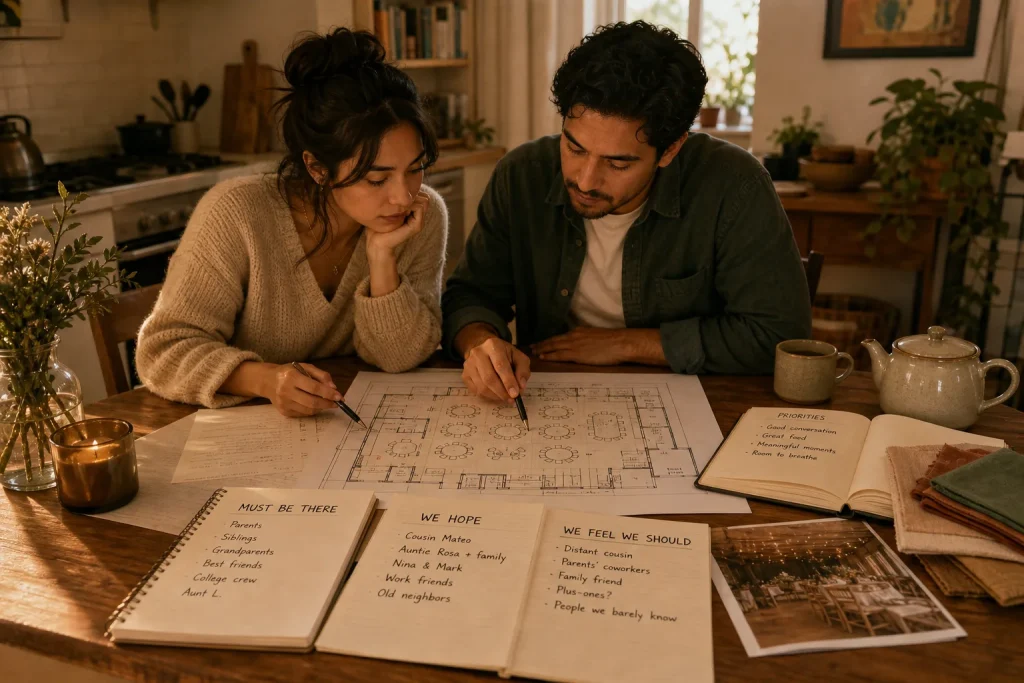
A hypothetical couple works through a guest-list range by starting with the gathering they want, the room they have, and the invitations that matter most.
Priorities · 6 min read
On a Sunday afternoon, Maya and Luis spread a venue floor plan across the kitchen table while a pot of tea cools beside it. Their first draft has names in three columns: “must be there,” “we hope,” and “we feel we should.” The total at the bottom is already making the celebration feel less like theirs. Instead of treating that number as a grade, they decide to use it as a planning tool.
They begin with the gathering they want to host
This is an invented situation, but the decisions are familiar. Maya and Luis are planning a wedding reception in a neighborhood arts hall. They want dinner, a few short toasts, and enough room for people to talk without shouting across crowded tables. Their first useful question is not “How many guests should a wedding have?” It is “What do we want the room to feel like?”
That answer gives the list a purpose. They picture a warm, sociable evening where guests can move between dinner tables and a small lounge area. They are not trying to stage a large dance party, and they do not want a long receiving line to set the evening’s rhythm. Those preferences suggest a gathering built around conversation, shared food, and time with people they know well.
Hosts can start with a few plain-language prompts:
- What moments do we most want to share with guests?
- Do we want a close-knit room, a broad family gathering, or something between them?
- Which people would we miss having in the room, beyond the photographs?
- What kind of interaction should the format make easy?
The answers are not a formula. They are a way to notice when a guest-list decision supports the occasion and when it is mainly an attempt to satisfy an imagined standard.
They check what the room can actually support
Maya and Luis look beyond the hall’s advertised capacity. A room’s maximum occupancy is not the same as a comfortable dinner setup. Tables, chairs, a buffet, a welcome area, accessible routes, and space for staff all shape how many people can be hosted well. They ask the venue coordinator for a floor plan showing the dinner arrangement they have in mind, then consider the practical details together.
They also ask what is included in the hall’s capacity figure and whether a seated meal changes the layout. The answers help them understand the room without treating one number as a target. If they filled every available place, they might need to change the setup or simplify parts of the evening. That is a real tradeoff, not a failure.
Space is only one part of the decision. The couple checks whether the caterer can serve the planned menu to the likely range of guests, whether the hall’s tables can be arranged to suit conversation, and whether the budget can support the event they want. They do not need exact costs at this stage to recognize that each added invitation affects food, seating, and the amount of time they can spend with guests.
It is not worth the effort to debate an abstract ideal guest count before checking the venue’s actual layout. A figure that sounds right on paper can become awkward once tables and circulation paths are drawn in.
They sort invitations by relationship, not obligation
Now Maya and Luis return to their three columns. The first contains people central to their lives: close family, longstanding friends, and a few relatives who have supported them through important changes. The second contains people they would be glad to see if the room and budget allow. The third includes names added mostly because someone else might expect them.
They discuss the third column carefully. Some of those relationships matter, but an invitation should reflect a genuine wish to share the occasion, not just fear of awkward questions. They consider context: Have they spent meaningful time together? Do they expect to keep building the relationship? Would inviting one person create a reasonable expectation to invite a whole group? None of these questions is a hard rule. Together, they help the hosts make choices they can explain to each other.
Imagine Maya’s aunt asks whether a distant cousin will be invited. Maya and Luis decide they would like the cousin there, but only if they can also include a small group of relatives with whom he is usually connected. They add the names to the “we hope” column, then check whether the room and budget can accommodate that choice. The observable result is a clearer conversation: the invitation is tied to a real family relationship and a deliberate group decision, not an automatic reaction to pressure.
They also agree on a shared principle for plus-ones and children, if those questions arise. Applying the same reasoning across similar situations helps avoid making every individual invitation feel like a separate negotiation. Their principle can still account for close relationships and practical circumstances; consistency does not mean pretending every guest’s situation is identical.
They turn one total into a workable range
With the purpose, room, and relationships in view, the couple stops trying to produce a single perfect number. They make a working range instead. The lower end covers the people they most want to host. The upper end includes additional guests they would be happy to invite if the layout and budget allow. The range gives them room to make decisions as real information comes in.
For each version, they check the same things: Does it preserve the kind of evening they described? Can guests sit and move comfortably in the proposed layout? Can they afford the food and service without cutting something they care about more? Are invitations being extended for a reason they both recognize?
Suppose the smaller version leaves room for a relaxed dinner and the added names would require squeezing tables together. The couple can decide that comfort matters more than expanding the list. If the floor plan accommodates the wider version without changing the experience, they can include more people. Either choice is valid; the point is to make the tradeoff visible.
A range also gives hosts a calmer way to discuss uncertainty. They can tell family members that the list is being shaped around the venue and the gathering they want, rather than promising invitations before those details are settled. It is easier to be kind and clear when the hosts have agreed on their own criteria first.
They make the result feel like their occasion
Maya and Luis compare both versions with the scene they imagined at the kitchen table. They choose the list that keeps the meal comfortable, leaves room for conversation, and includes the people they most want beside them. They then revisit the “we hope” names together, adding invitations only where space and resources support them.
The final list is not a score of popularity, family standing, or the importance of the relationship. It is a set of hosting choices made for this particular celebration. Another couple, in another room, might reach a different result and still be equally thoughtful.
For any host, the useful question is not whether the guest count looks impressive. It is whether the people invited, the space arranged, and the event’s rhythm fit together. When those choices are aligned, the number becomes what it should have been all along: a practical way to shape a gathering people can enjoy.